
As you consider a career change, you may wonder if relocating to a new area can spark a significant transformation in your medical career. You might be looking for a fresh start, new challenges, or enhanced opportunities. Your decision to relocate can have a profound impact on your professional growth, allowing you to explore different specialties, develop new skills, and expand your network. This move can be a catalyst for a paradigm shift in your career, leading to personal and professional fulfillment.———-Embracing Change
To commence on a successful relocation, you must be open to new experiences and perspectives. This mindset allows you to approach challenges with a fresh outlook, leading to personal and professional growth.
Recognizing the Need for a New Challenge
Among the factors that drive your desire for change, a sense of stagnation in your current role may be a significant motivator. You may feel that your skills are not being utilized effectively, prompting you to seek new opportunities.
Overcoming Fear and Doubt
By taking small steps towards your goal, you can build confidence and develop a growth mindset. You will begin to see that your capabilities extend beyond your current role, and that relocation can be a catalyst for positive change.
Plus, as you navigate the process of overcoming fear and doubt, you will develop resilience and learn to reframe challenges as opportunities for growth. You will start to see that your relocation is not just a physical move, but a transformation that can revitalize your career and personal life, allowing you to pursue new passions and interests that align with your values and goals.
New Horizons
Clearly, relocating to a new place can be a life-changing experience, and for a doctor, it can bring new opportunities and challenges that can catalyze a paradigm shift in their career, allowing you to grow professionally and personally.
Exploring New Specializations and Interests
With the flexibility to explore different aspects of medicine, you can discover new specializations and interests that align with your skills and passions, enabling you to expand your expertise and stay updated with the latest advancements in the field.
Discovering Hidden Talents and Passions
On the path to self-discovery, you may uncover hidden talents and passions that can enhance your career and personal growth, as you step out of your comfort zone and take on new challenges, you will be able to identify areas where you can improve and develop new skills.
Horizons of new opportunities emerge as you investigate deeper into discovering your hidden talents and passions, you will find that your career as a doctor is not just about treating patients, but also about growing as a professional, and you will be able to make a more significant impact in your field, leading to a more fulfilling career.
Career Revitalization
Even a move to a new location can be just what you need to revitalize your career as a doctor, bringing new opportunities and challenges that can help you grow professionally and personally.
Reigniting Passion for the Medical Field
Foregrounding your skills and experience in a new environment can help you regain your passion for the medical field, allowing you to approach your work with renewed energy and enthusiasm, and you may find that your relocation sparks a new interest in a specific area of medicine.
Finding New Purpose and Meaning
By embracing the change that comes with relocation, you can discover new aspects of your profession that bring you fulfillment, and you may find that your new location offers opportunities for community involvement or medical research that align with your values and interests.
Due to the potential for new experiences and challenges, you may find that your relocation helps you develop a fresh perspective on your career, allowing you to identify what truly motivates and satisfies you as a doctor, and you can use this insight to make intentional decisions about your future and create a more fulfilling career path.
Networking and Building Connections
Your relocation can be a catalyst for expanding your professional network, allowing you to meet new people and form meaningful connections in your field.
Establishing a New Professional Network
One of the first steps in building a new network is to attend industry events and conferences, where you can meet fellow professionals and establish relationships that can benefit your career.
Collaborating with Peers and Mentors
Building on your new connections, you can start collaborating with peers and mentors, sharing knowledge and expertise to achieve common goals and advance your career.
Consequently, as you work with your peers and mentors, you will have opportunities to learn from their experiences, gain new insights, and develop your skills, ultimately enhancing your professional profile and opening up new career possibilities for you.

Personal Growth and Development
Many doctors undergo significant personal growth when they relocate, leading to a paradigm shift in their career. You may experience new challenges, develop new skills, and gain a fresh perspective on your profession.
Developing Emotional Intelligence and Resilience
By navigating new environments and situations, you will develop emotional intelligence and resilience, enabling you to better cope with the demands of your profession and provide more empathetic care to your patients.
Cultivating a Growth Mindset
Besides acquiring new skills, you will also cultivate a growth mindset, allowing you to approach challenges with confidence and enthusiasm, and view failures as opportunities for growth and improvement.
Growth mindset is necessary for your continued development as a doctor, and relocating can be the catalyst for this shift in your thinking, enabling you to stay adaptable, motivated, and committed to your profession, and you will find that your career is reinvigorated and refreshed as a result.
Navigating Challenges and Obstacles
Now that you’ve relocated, you’ll encounter various challenges that can impact your career. You must adapt to a new work environment, build a new network, and navigate local healthcare regulations.
Managing Stress and Burnout
On the path to settling into your new role, you’ll face stress and burnout. You should prioritize self-care, maintaining a healthy work-life balance to ensure your well-being.
Staying Focused and Motivated
An crucial part of your relocation is setting clear goals and staying motivated. You can achieve this by tracking your progress, celebrating milestones, and seeking support from colleagues and mentors.
Burnout can be a significant obstacle, but by staying focused on your objectives, you’ll find that your relocation can be a catalyst for growth, allowing you to develop new skills and expand your professional network, ultimately enhancing your career prospects and job satisfaction, as you settle into your new role, you’ll find that your decision to relocate was a turning point in your career, offering you new opportunities and challenges that will help you grow as a professional.
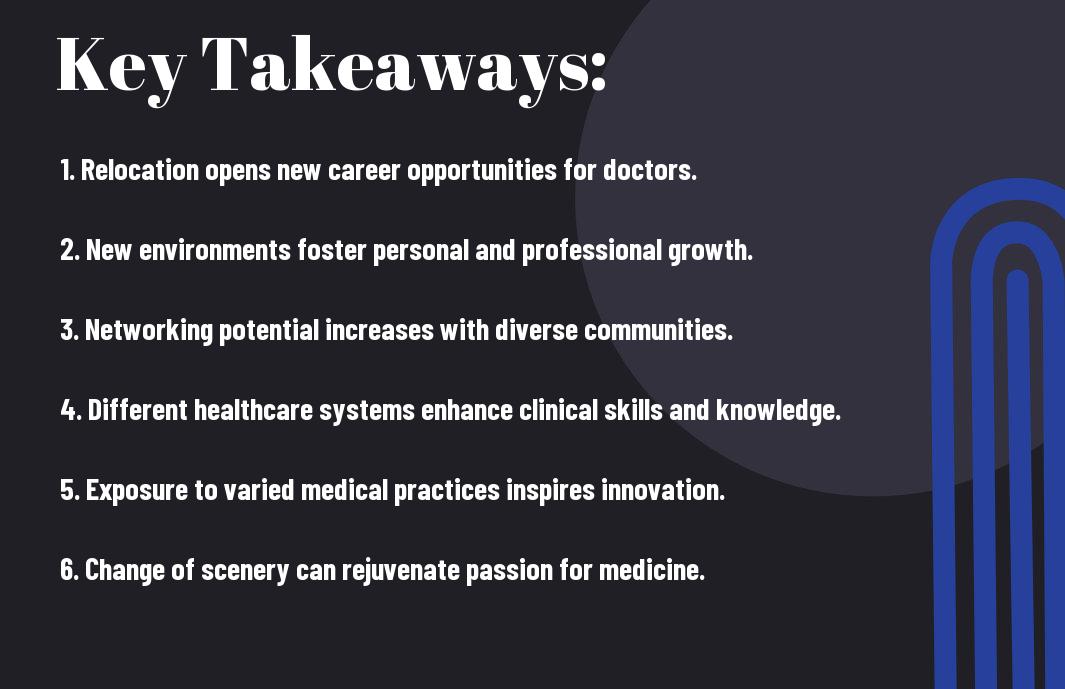
To wrap up
From above, you can see that a doctor’s relocation can indeed catalyze a paradigm shift in their career. As you consider this option, you’ll find that your new environment can bring fresh opportunities, challenges, and perspectives. Your career can transform, leading to personal and professional growth, and you can emerge as a more competent and confident doctor, with your skills and expertise enhanced by your new experiences. You can look forward to a renewed sense of purpose and fulfillment in your career.
FAQ
Q: What factors contribute to a doctor’s decision to relocate, and how can it impact their career?
A: A doctor’s decision to relocate can be influenced by various factors, including personal reasons such as family ties, lifestyle preferences, or a desire for a new challenge. Professionally, they may be drawn to new opportunities for career advancement, specialized training, or a more desirable work-life balance. Relocation can catalyze a paradigm shift in a doctor’s career by exposing them to new medical practices, technologies, and collaborative environments, potentially leading to enhanced skills, increased job satisfaction, and a renewed sense of purpose.
Q: How can a doctor’s relocation lead to a paradigm shift in their career, and what are the potential benefits?
A: A doctor’s relocation can lead to a paradigm shift in their career by providing access to new and innovative medical approaches, allowing them to stay updated with the latest research and technologies. This shift can also bring about changes in their professional network, offering opportunities to collaborate with renowned experts and like-minded professionals. The potential benefits of such a shift include broadened perspectives, improved patient outcomes, and enhanced career prospects, ultimately contributing to a more fulfilling and successful medical career.
Q: What steps can a doctor take to ensure a smooth transition and maximize the career benefits of relocation?
A: To ensure a smooth transition and maximize the career benefits of relocation, a doctor should thoroughly research their new location, understanding the local healthcare landscape, and the specific needs and challenges of the community they will be serving. They should also update their professional credentials, licenses, and registrations as required by the new location. Building a network of contacts in the new area, both within and outside their specialty, can provide invaluable support and insights. Furthermore, being open to new experiences, embracing the challenges of relocation, and maintaining a flexible and adaptable attitude are key to navigating this significant career change successfully.