
With clear timelines, verified moving specialists, secure medical records transfer, and proactive staff communication, you ensure efficient relocation, minimize downtime, and maintain patient trust during your move.
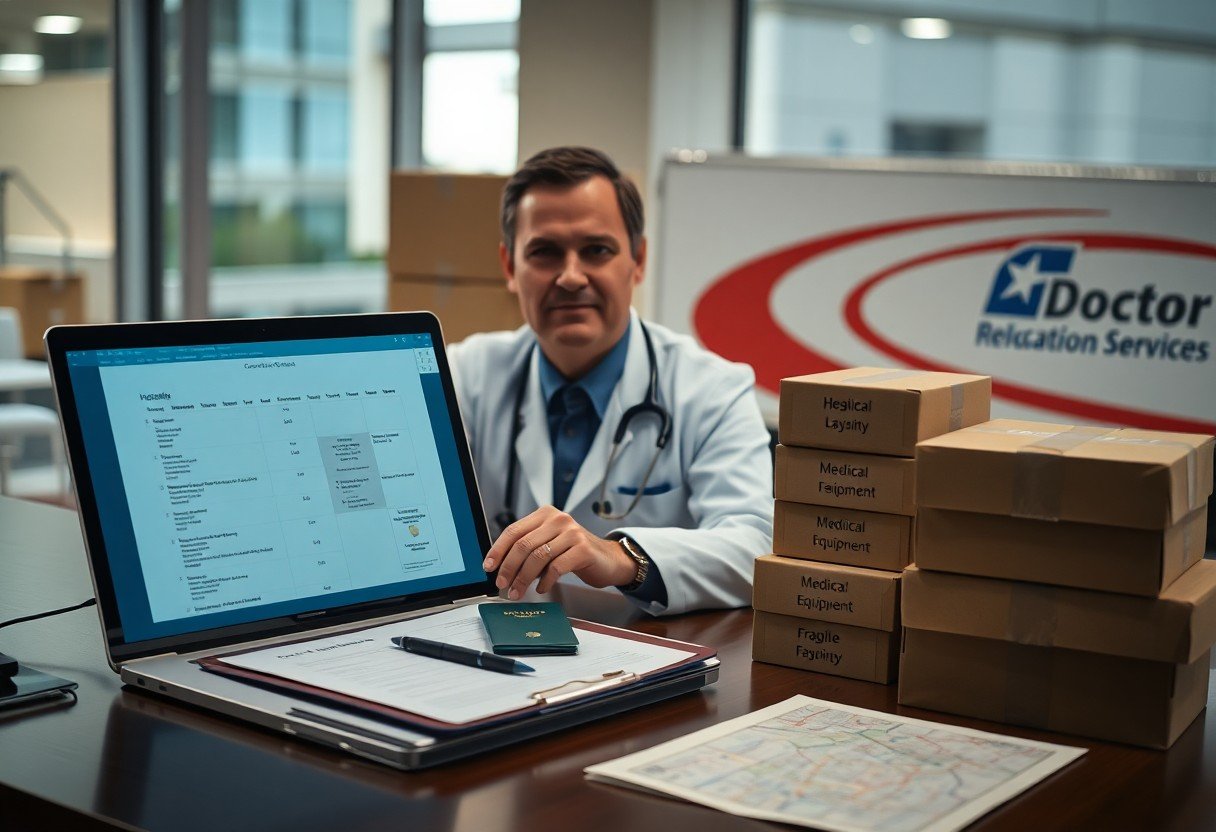
Pre-Move Planning and Credentialing Coordination
Plan credentialing early: you should gather licenses, board documents, malpractice records and targeted CV updates while coordinating with hospital credentialing teams and relocation specialists to prevent delays.
Navigating State Licensing and Board Certification Portability
Consult state boards early; you must confirm licensure timelines, reciprocity options, and any exam or training requirements while submitting primary-source verifications to minimize approval gaps.
Aligning Relocation Timelines with Hospital Start Dates
Confirm move schedules against credentialing and orientation deadlines so you arrive ready for board reviews, ID badge issuance, and department onboarding.
Coordinate a backward timeline from your official hospital start date, mapping license application windows, primary-source verification, credentialing committee cycles, and mandatory orientation. Build in at least four to eight weeks of buffer for background checks, facility-specific privileging, and any board responses. Keep recruiters and relocation partners updated weekly so you can adjust travel, housing and temporary clinical coverage if approvals slip.
Evaluating Specialized Physician Relocation Services
Evaluation of specialty relocation providers focuses on clinical experience, staff credentials, and documented case histories so you can assess fit quickly.
Criteria for Selecting Medical-Specific Moving Firms
You should prioritize firms with medical licensing familiarity, detailed inventories, HIPAA-aware protocols, and insurance that covers clinical assets, plus clear timelines and references from clinics or hospitals.
Assessing White-Glove Handling for Clinical Equipment
Inspection of white‑glove services verifies packing methods, climate control, transit monitoring, and credentialed technicians so you can protect delicate devices.
Verify that movers use custom crating, shock and tilt indicators, humidity control, trained biomedical handlers, and chain‑of‑custody documentation; ask for equipment handling SOPs, insurance specifics, calibration logs, and the option for on‑site mock transfers or supervised unpacking to confirm performance.
Financial Management of the Professional Transition
Budgeting forces you to align moving costs with your salary and benefits; prioritize employer reimbursements and set aside an emergency fund to cover unexpected expenses during the relocation period.
Maximizing Employer-Provided Relocation Stipends
Use all available stipend options, itemize receipts, and negotiate coverage for temporary housing and travel so you capture the full value; secure written confirmation of approved expenses before paying out of pocket.
Managing Tax Implications of Multi-State Moves
Track residency rules, withholding differences, and moving-expense deductions so you avoid unexpected tax liabilities; consult a tax pro to clarify your state filing obligations and deadlines.
Review your pre-move checklist for state residency tests, reciprocal agreements, and estimated tax payments; keep detailed moving expense records, timestamps for your workdays in each state, and copies of employer reimbursements to support your filings, reduce audit exposure, and determine whether you must file multiple state returns.
Strategic Real Estate and Housing Acquisition
Plan real estate moves around commute times, school options, and resale potential; have your realtor experienced with physician relocations secure targeted listings, negotiate favorable closing timelines, and coordinate temporary housing while you complete credentialing.
Utilizing Physician-Specific Mortgage and Loan Programs
Apply for physician mortgage programs that waive private mortgage insurance and accept higher debt-to-income ratios; compare interest rates, down-payment rules, and relocation incentives so you choose options that fit your contract length.
Analyzing Residential Proximity for On-Call Requirements
Assess on-call routes by timing drives during shift changes, noting traffic chokepoints and alternate paths; ensure you have reliable parking, direct hospital entry access, and safe lighting for night returns.
You should map typical and worst-case travel times to the hospital at different hours, using live-traffic apps and doing test drives on call nights; factor in an extra buffer for weather, construction, and peak traffic, confirm permit and staff-parking logistics, and verify whether hospital shuttles serve nearby streets. Also consider local noise, nearby caregiver options for overnight shifts, and renting closer temporarily while you evaluate long-term commute consistency.
Facilitating Family and Spousal Integration
Your relocation team arranges spousal career resources, family housing options, school searches, and community introductions so you and your loved ones adjust quickly and with less stress.
Accessing Career Support for Healthcare Partners
Spouses can tap employer networks, licensing guidance, and job-placement services your relocation advisor provides to help you pursue clinical or alternative careers.
Streamlining Educational Transitions for Dependents
Children benefit from school assessments, enrollment coordination, and transfer of records that your relocation team manages to minimize disruption in learning.
You can request a tailored school-transition plan covering enrollment deadlines, transcript transfers, standardized testing, and special-education assessments so your child keeps academic progress. Relocation specialists coordinate with districts to confirm curriculum equivalencies, arrange placement testing, and secure temporary transcripts when needed. Ask for introductions to counselors and local parent groups, and request language-support services or credit-evaluation assistance to reduce delays and help your dependent settle academically.
Post-Arrival Administrative Logistics
You should complete local licensing, credentialing, HR paperwork, EHR access, payer enrollments, facility privileges, and utility/setup tasks promptly to minimize clinical downtime.
Updating DEA Registrations and Malpractice Insurance
Confirm that your DEA registration reflects the new address or apply for state-specific numbers if relocating; update malpractice policy dates, carriers, and coverages, and secure tail or prior-acts coverage as required.
Establishing Local Professional and Referral Networks
Connect with local specialists, hospital contacts, primary-care colleagues, and referral coordinators; introduce your services, clarify referral criteria, and schedule meetings to streamline patient handoffs.
Build relationships by attending medical society meetings, arranging case-review sessions, sharing electronic referral protocols, exchanging contact details, and tracking referral outcomes to measure patient flow and quality.
Final Words
As a reminder, you should confirm licensing and credential transfers, set patient-notification and record-transfer timelines, secure moving and IT support, and review contracts and insurance to minimize downtime and maintain care continuity during the move.