
Many health systems underestimate how your housing stability directly influences retention, community integration, and the quality of care you provide; by supporting safe, affordable housing and relocation assistance, employers reduce turnover, strengthen local ties, and enable you to focus on patient outcomes rather than logistics, making long-term program success and healthier communities more attainable.
The Importance of Physician Housing Support
You see housing support directly affect operational costs and patient access: estimates place physician replacement costs between $250,000 and $1,000,000, and vacancies can lengthen service gaps. When you provide relocation assistance, short-term rentals, or employer-owned units, turnover falls and clinic continuity improves; many systems report vacancy reductions of 20-40% and faster onboarding, translating into measurable gains in access and quality metrics.
The Impact on Recruitment and Retention
You acquire candidates faster when you remove housing uncertainty: housing ranks among the top relocation factors, and offering a stipend or temporary housing often converts hesitant candidates, with employers reporting double-digit improvements in offer acceptance. You also ease partner-employment and schooling transitions, shortening the settling period; reduced commute times and guaranteed housing help you keep physicians past the common 1-3 year turnover window in underserved areas.
Housing Challenges Faced by Physicians
You face high debt burdens-median medical school debt is around $200,000-while entering competitive housing markets where rents and down-payment requirements impede quick moves. Relocation timing seldom aligns with credentialing, so temporary housing becomes necessary; locum tenens and fellowship end-dates create gaps. Dual-career couples often find limited local job options, and scarce nearby inventory forces long commutes that increase burnout risk and reduce on-call reliability.
To mitigate these barriers, you can deploy targeted solutions: create short-term furnished units for onboarding, offer bridge loans or down-payment assistance, and partner with local employers to expand spouse employment pipelines. For example, one regional system built 12 employer-owned apartments and used a three-month furnished rental program that cut start-date cancellations by over 25%. You should also engage planners to expedite permits and pursue zoning variances to grow nearby 2-3 bedroom availability.
Community Integration and Physician Well-Being
When you live where you work, your stressors change: commute times drop, on-call turnover falls, and informal support networks grow. With physician burnout rates often exceeding 40%, housing support that cuts a 30-45 minute commute to under 15 minutes can free 5-10 hours weekly for rest or family. In practice, health systems offering nearby rentals report measurable gains in retention and patient continuity, because you’re more available, more present, and better able to sustain demanding schedules over years.
Enhancing Work-Life Balance
By placing you within walking or short-drive distance of the clinic, housing programs shave daily travel time and reduce schedule friction: a 30-minute commute saved each way adds roughly 5-10 hours monthly back to your life. That time often translates into better sleep between shifts, more predictable child-care arrangements, and higher likelihood of taking vacation. In turn, you experience fewer missed calls, lower fatigue-related errors, and greater satisfaction with both career and personal commitments.
Building Stronger Community Ties
Living locally boosts the informal interactions that build trust-patients see you at school events, farmer’s markets, or community meetings, which accelerates rapport and adherence. Clinicians who reside in their service area report deeper understanding of social determinants, leading to more tailored care plans and higher follow-up rates. For example, physicians embedded in community housing are often tapped for local advisory roles, strengthening two-way investment between you and the population you serve.
Digging deeper, your physical presence enables partnerships that clinics alone struggle to form: you can collaborate directly with schools on asthma programs, work with churches on vaccination drives, or coordinate with social services for complex discharges. These activities often produce measurable gains-lower no-show rates, improved preventive screening uptake, and smoother care transitions-because trust and accessibility drive patient behavior. When you participate as a neighbor, not just a provider, community health outcomes and your professional resilience both improve.
Financial Implications of Housing Support
Cost-Benefit Analysis for Healthcare Facilities
You can quantify housing support against hard recruiting and vacancy costs: physician recruitment often ranges $250,000-$1,000,000 including sign-on bonuses and lost revenue, while locum tenens can run $1,500-$3,000+ per day. Providing a housing stipend of $18,000-$40,000 per year or a facility rental at $1,200-$2,500/month frequently costs less than a single replacement hire. Using these figures, even a 10-20% reduction in turnover yields a measurable positive ROI within 1-3 years.
Long-Term Economic Benefits
Sustained housing support stabilizes staffing and patient panels, which preserves revenue streams and reduces episodic backfill costs; for example, preventing one replacement a decade can save you $250,000-$500,000 in recruiting and ramp-up losses, while averted locum usage keeps operating margins intact. That steadiness also improves contract negotiations and payer relationships tied to consistent quality metrics and volumes.
To illustrate, assume you provide a furnished rental valued at $18,000/year. If that housing prevents one physician turnover every 10 years, you avoid roughly $300,000 in recruitment and lost productivity-an annualized savings of $30,000 versus the $18,000 annual housing expense, netting $12,000/year. Layer on avoided locum fees (e.g., $2,000/day for 60 days = $120,000) and improved patient retention that supports outpatient revenue, and the multi-year ROI grows substantially. You should also factor in indirect gains: stronger community ties reduce onboarding friction, lower credentialing delays, and improve quality metrics that can increase incentive payments and reduce penalty exposure.
Models of Effective Housing Support Programs
You can combine short-term relocation bonuses, medium-term rental subsidies, and long-term solutions like employer-owned housing or down-payment assistance to create layered support that matches physician lifecycle needs. Programs offering $5k-$25k upfront plus 1-3 years of rental support have shown up to 30% better retention in underserved sites, while employer-owned units cut vacancy durations dramatically when paired with targeted recruitment and local developer partnerships.
Case Studies from Successful Initiatives
You can draw lessons from diverse pilots: rural networks using $20k stipends, urban systems building clinician housing, state loan-repayment pilots tied to homeownership, and public-private projects reserving units for health staff-each produced measurable drops in vacancy, faster time-to-fill, and higher multi-year retention versus baseline.
- Rural Midwest health system: $20,000 relocation + 24-month rental subsidy; physician vacancy fell 45%, 3‑year retention rose from 42% to 65%, and average time-to-fill dropped from 210 to 90 days.
- Urban safety-net hospital: employer-owned 30-unit portfolio; first-year turnover decreased 22%, clinician applications rose 60%, and unit occupancy stabilized at 95% within three months.
- State loan-repayment + down-payment pilot: option of $50,000 loan repayment or $25,000 down-payment aid; 3-year retention increased to 68% from 40% baseline; program cost per retained physician ~ $38,000 with positive ROI by year three.
- Mountain West public-private partnership: 40 clinician-designated rentals built; units filled 90% within six months, average clinician commute cut by 35 minutes, recruitment yield improved 80% year-over-year.
- Telehealth hub + co-living model: four clinicians per shared home + $500/month subsidy; turnover fell 30%, on-call coverage reliability improved 40%, and annual housing subsidy per clinician averaged $6,000.
Best Practices for Implementation
You should base program design on a local needs assessment, tier incentives by specialty and scarcity, include clear duration and clawback terms, and set measurable goals (vacancy rate, time-to-fill, 1/3/5-year retention). Pilots of 12-18 months let you test cost-per-hire assumptions and adjust incentives before scaling.
You’ll want a phased rollout: start with a 12‑month pilot targeting one service line, set targets (e.g., reduce time-to-fill by 50%, raise 3‑year retention by 20 percentage points), and require data collection on costs and outcomes. Negotiate developer agreements that reserve 20-30% of units for clinicians, build clawback clauses tied to service commitments, and align tax/benefit counseling for participants. Financial modeling should compare housing investment to replacement cost (typically 1-2 years’ salary) and include sensitivity runs for retention improvements; governance should assign HR, finance, and community liaisons to monthly reviews and a formal 12‑ and 36‑month evaluation to decide scale-up.
Policy Recommendations
With the AAMC projecting a physician shortfall of up to 139,000 by 2033, you should press for targeted policy changes: expand loan-repayment and NHSC-style programs, authorize J‑1 waiver incentives tied to housing, and unlock financing tools like LIHTC and TIF for workforce housing. Embed explicit housing allowances in rural and safety-net recruitment packages, and require outcome reporting (retention, vacancy rates) so you can track which incentives deliver measurable returns.
Advocating for Supportive Legislation
You can lobby state and federal lawmakers to codify housing as an eligible incentive for recruitment and retention: propose bills that allow employers to offer pre-tax housing stipends ($1,000-3,000/month ranges), expand NHSC loan-repayment housing components, and streamline zoning waivers for clinician housing near clinics. Cite local vacancy data and cost-savings from reduced turnover to make the fiscal case to budget committees and health departments.
Collaborating with Community Stakeholders
Engage health systems, local governments, CDCs, housing authorities, and community banks to pool resources-use LIHTC, CDBG funds, or land-banking to build clinician units. You should negotiate ground leases, guaranteed occupancy clauses, and sliding-scale rents so developers see predictable cash flow while you secure near-site housing that directly supports staffing needs.
Start by mapping assets and convening a stakeholder table, then pilot 10-20 units to test lease terms and support services; measure retention at 12 and 36 months and calculate cost per retained clinician. You can leverage MOUs to share risk, apply for state workforce housing grants, and use local employer contributions to match federal credits, creating replicable models for neighboring communities.
Future Trends in Physician Housing
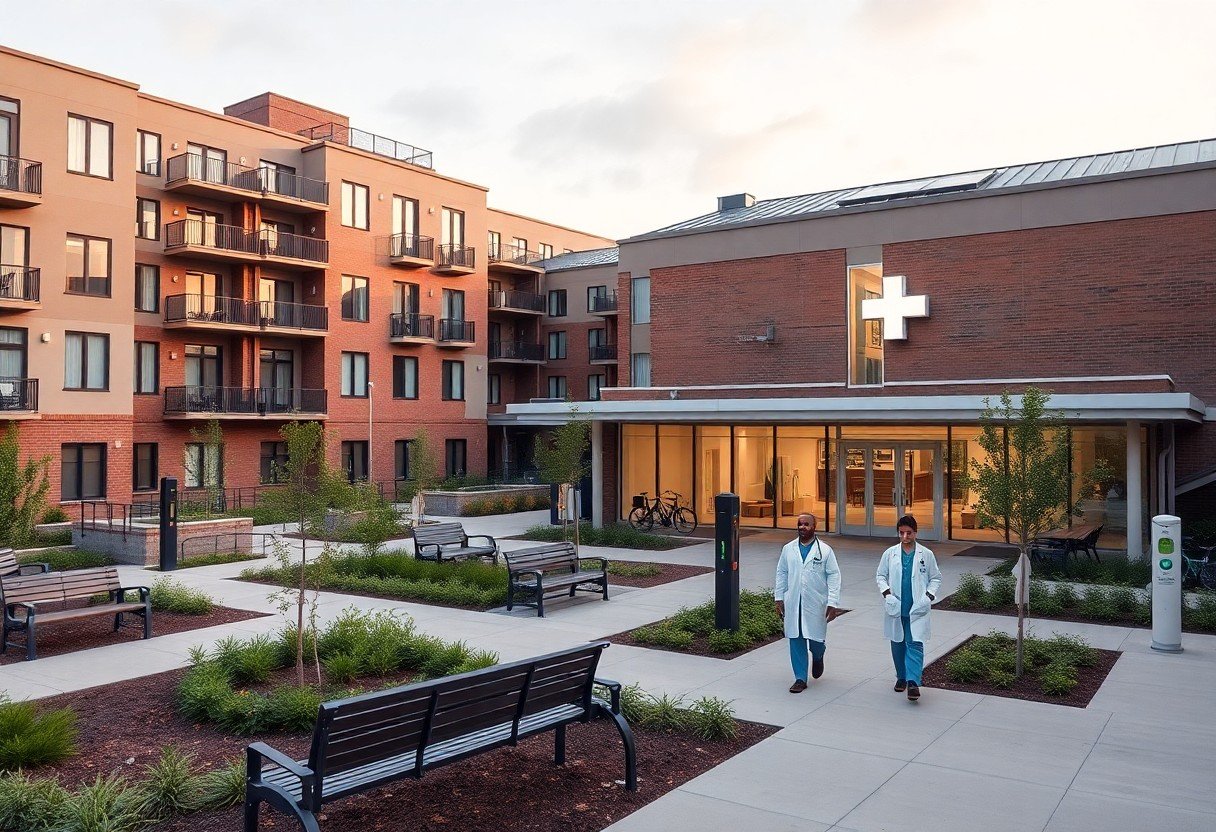
As staffing models shift and retention pressures grow, you’ll see housing become a strategic recruitment tool tied to total compensation; replacing a physician can cost roughly 0.5-1.0× their annual salary, so affordable, near-campus living directly protects operating capacity. Expect more health systems to budget for housing stipends, employer-owned rentals, and transit-linked developments within 0.5 mile of campuses to shorten commutes and speed onboarding.
Evolving Needs in the Medical Field
With more dual-career households and part-time schedules, you need flexible leases, bundled family services, and proximity to quality schools and childcare; younger physicians prioritize work-life balance and local amenities when choosing roles. Specialties with high burnout and frequent relocations-like emergency medicine and hospital medicine-show greater sensitivity to immediate, furnished housing options and commute times under 20 minutes.
Innovations in Housing Solutions
Modular construction, micro-units (300-450 sq ft), and co-living models let you scale physician housing quickly and affordably; modular can cut build time by up to 50% and lower on-site labor needs, while employer-sponsored stipends of $1,000-2,500/month bridge market gaps. You’ll also see housing tied to loan-repayment packages and retention cliffs to align incentives.
For implementation, look at pilots that combine 12-36 modular or converted units adjacent to facilities, furnished and managed by the employer. You’ll benefit from shorter vacancy cycles-many programs report full occupancy within weeks-and predictable budgeting through fixed-rate leases or stipend formulas. Integrating telehealth-ready workspaces and bike-share access further increases appeal for early-career recruits.
To wrap up
With this in mind, supporting physician housing bridges clinical excellence and community stability, helping you attract and retain skilled clinicians, reduce burnout, and foster long-term local investment; when you align housing initiatives with practice goals, your organization gains continuity of care, stronger patient relationships, and measurable return on community health outcomes.